A Franklin Guide to Garage Door Opener Noise, Cost, Strength, and Safety
A surprising fact comes before any drive comparison. Federal safety rules apply to residential garage door openers made for United States sale on or after January 1, 1993. Therefore, chain drive vs. belt drive openers should never be judged by sound and price alone. Moreover, safety design, door balance, proper sizing, and correct setup matter just as much. Ultimately, the best choice for Franklin homeowners depends on the garage location, the door, daily use, comfort goals, and budget.
AI Overview
Chain drive vs. belt drive openers use the same basic idea. First, a motor moves a trolley along an overhead rail. However, a chain model uses a metal chain, while a belt model uses a reinforced belt. Therefore, the main daily difference is usually sound and vibration. For that reason, a belt drive is often the better comfort choice near bedrooms or living rooms. In contrast, a chain drive often offers a lower starting price and proven service for detached garages.
Still, drive type does not decide everything. Motor design, lifting force, door balance, rail length, controls, safety sensors, and installation quality also shape performance. Moreover, modern belt units can move many heavy residential doors. Likewise, modern chain units with direct current motors can run more smoothly than older chain models. Ultimately, the right answer comes from comparing complete systems, not two materials.
- In particular, choose a belt drive when quiet travel and low vibration have high value.
- Alternatively, choose a chain drive when price matters more and garage noise stays away from living space.
- Specifically, compare exact models because speed, power, warranty, lighting, and smart tools vary.
- Above all, inspect the door first because an opener should move a balanced door, not fight a damaged one.
How Chain Drive vs. Belt Drive Openers Really Work
First, both systems place a power unit near the garage ceiling. Next, that unit moves a trolley along a rail. Then, a door arm links the trolley to the garage door. As the trolley travels, the door opens or closes.
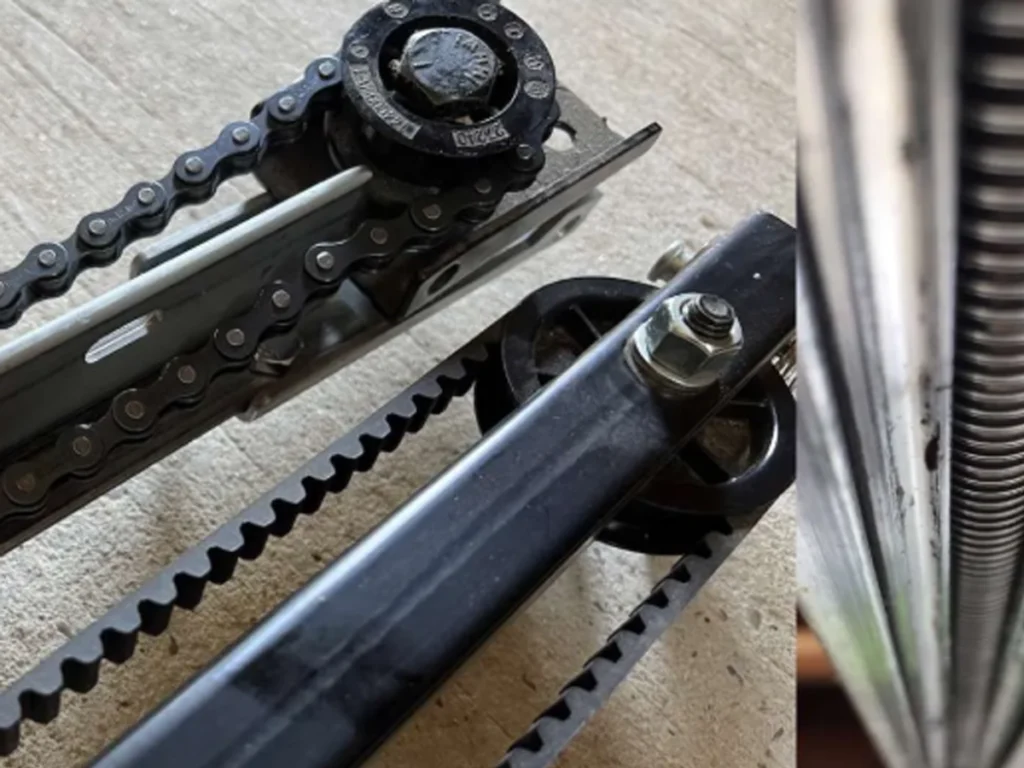
However, the transfer part differs. Specifically, a chain opener uses a metal roller chain, much like a bicycle chain. Meanwhile, a belt opener uses a strong belt that may contain steel reinforcement. Because the belt avoids metal contact along the rail, it usually sends less sound and vibration into the building.
Therefore, the drive is not the spring system. Also, it is not the full source of lifting power. Instead, it carries motion from the motor to the trolley. Consequently, this point explains why buyers must compare the entire opener and door system.
- In practice, the chain is a durable transfer part that can create more mechanical sound.
- By comparison, the belt is a smooth transfer part that usually creates less vibration near living space.
7 Key Differences That Shape a Smart Choice
Overall, the clearest comparison uses seven factors. Therefore, avoid choosing from one slogan, one price tag, or one old story.
1. Operating sound
Belt drives usually make less rail noise because a reinforced belt replaces the moving metal chain. Therefore, they often suit attached garages. By comparison, chain models can be more noticeable, especially when the garage shares framing with a bedroom. However, a newer chain model may still sound better than an old, worn opener.
2. Vibration
Meanwhile, sound travels through the air, while vibration travels through framing. Therefore, vibration can matter even when the opener itself does not seem very loud. Similarly, belt systems usually transmit less vibration.
3. Starting cost
Generally, chain drives enter the market at a lower price point. In contrast, belt drives commonly appear as an upgrade. However, price gaps vary by motor, lighting, battery backup, cameras, controls, rail length, and warranty.
4. Routine care
A chain system has metal links, a sprocket, and a tension setting. Therefore, inspection can include chain condition, tension, fasteners, and sound changes. By contrast, a belt does not need chain lubrication. Still, belt tension, pulleys, mounting points, sensors, rollers, and door hardware need attention.
5. Strength and door fit
At first, many buyers assume every chain is stronger than every belt. However, that statement is too broad. In fact, steel reinforced belt systems can serve many standard, insulated, and heavier residential doors. More importantly, the door must be balanced by its spring system. Therefore, model capacity and door condition matter more than a simple chain versus belt label.
6. Opening speed
Notably, drive material alone does not set speed. Instead, the motor, control design, travel settings, rail, and model specifications shape movement.
7. Feature choice
Likewise, both drive types can include phone control, battery backup, bright lighting, keypads, cameras, alerts, and soft movement. Therefore, buyers should separate drive choice from feature choice.
- First, compare sound, vibration, cost, care, strength, speed, and features on the same page.
- Next, compare complete models with similar power, rail length, controls, warranty, and installation needs.
The Quiet Relief Test for Attached Franklin Homes
Notably, noise becomes personal when the garage touches daily living space. For example, an early departure may wake someone in a room above the garage. Likewise, a late arrival may send a low vibration through a nearby wall.
Therefore, start with the home layout. For that reason, a belt drive usually earns its added cost when quiet use protects sleep, calls, study, or family time. In contrast, a detached garage may keep chain noise far enough away.
However, the drive is only part of the sound. Moreover, worn rollers, loose hinges, dry bearings, weak mounting, poor balance, and an aging motor can add noise. Also, direct current motors with soft start and stop controls can reduce sudden movement.
- In particular, pick belt drive comfort when bedrooms, offices, or living rooms share the garage structure.
- Alternatively, consider chain drive value when the garage is detached and sound has little effect indoors.
A Critical Truth About Power, Weight, and Balance
Above all, the opener should guide a balanced door. Therefore, it should not serve as a cure for weak springs, binding tracks, or damaged rollers. Nevertheless, a stronger motor may hide a problem for a short time, but it does not repair the door.
Before selecting either drive, a technician should check manual movement and balance. advises closing the door before using the manual release. Then, the door should move freely and remain partly open during a balance check. However, springs, bottom brackets, cables, and related supports carry high tension.
Consequently, this point changes the buying decision. For example, a reinforced belt model may handle a properly balanced insulated door very well. Likewise, a chain model may struggle when the same door binds. Therefore, ask for a door assessment before comparing motor labels.
- First, check door balance, track movement, rollers, springs, and mounting before sizing the opener.
- Above all, never select extra power as a substitute for correcting a damaged or unbalanced door.
How to Avoid a Costly Choice and Protect Value
First price matters, but total value matters more. Generally, a chain drive costs less at the start. Therefore, it can be a sound choice for a detached garage, rental, workshop, or strict project budget. A belt drive often costs more because quiet travel and smooth motion hold added value.
However, the final quote may include much more than the power unit. For example, rail extensions, battery backup, extra remotes, a keypad, and smart controls can change the total. In addition, new brackets, wiring, haul away, and labor can change it. Also, a poor fit may cost more later through noise complaints, repeated service, or an early replacement.
Ultimately, our practical opinion is simple. First, do not pay for quiet that has no value in your layout. Still, do not save a modest amount when garage noise will affect sleep every day. Therefore, the best value is the unit that solves the real problem.
- Specifically, ask for an itemized quote that names the model, rail, controls, accessories, labor, and warranty.
- Overall, judge value through daily comfort, expected use, service access, and complete installed cost.
Reliable Care That Helps Your Opener Last
Certainly, neither drive type is free from care. Therefore, follow the exact owner manual for the installed model. In fact, Genie states that maintenance varies by model, which is why broad advice should not replace product instructions.
First, for a chain system, listen for new rattle, slap, grinding, or uneven travel. Also, check whether the chain appears too loose or unusually tight. However, do not change tension without the correct procedure. Next, for a belt system, watch for fraying, damaged teeth, poor tracking, or unusual sag.
Meanwhile, maintain the whole door. Specifically, monthly visual checks should include hinges, rollers, springs, panels, sensors, and mounting. In addition, the door should move freely when safely disconnected.
- First, record the model and serial number, then keep the correct manual near the garage.
- Finally, schedule service when sound, speed, balance, reversal, or remote response changes without a clear cause.
Powerful Features Beyond the Drive System
Importantly, a drive choice does not decide the full user experience. Therefore, compare the motor and control package as carefully as the chain or belt. For example, direct current motors often support soft start and stop movement. Also, many current units offer battery backup, phone alerts, remote control, bright lighting, or video tools.
Still, availability differs by model. For instance, some chain units include strong smart features. Likewise, some belt units focus mainly on quiet use. Therefore, write a required feature list before shopping.
In particular, battery backup for Franklin homes can support access during a power loss. Smart alerts can also warn that a door remained open. However, connected tools depend on network signal, app support, account setup, and product compatibility. Ultimately, these tools add value only when they fit the household.
- First, required features may include safety sensors, suitable lift force, correct rail length, and secure controls.
- Next, optional features may include battery backup, phone access, cameras, motion lighting, and delivery tools.
Two Honest Franklin Case Studies
Importantly, the following cases are composite examples. Therefore, they show a sound decision process without claiming results for named customers.
Composite case one: Attached garage below a bedroom
For example, a Franklin household has an attached two car garage. Also, a bedroom sits above the opener rail. Notably, the existing door moves freely and passes a balance check. However, the old opener sends vibration through the ceiling during early departures.
In this case, our opinion favors a belt drive with a direct current motor and soft movement. Therefore, the expected benefit is lower transmitted noise, not more basic lifting strength. A battery backup may also fit the household plan. Still, final selection depends on door size, model capacity, rail length, and inspection.
Composite case two: Detached garage used as a workshop
Another property has a detached garage with no nearby sleeping space. Likewise, the door is standard, balanced, and used several times each day. However, the owner values a simple budget and easy access to common replacement parts.
Here, a chain drive may offer the better fit. Noise has less effect on the house, so the price advantage holds more value. Smart controls can still be included when the chosen model supports them. Again, the expected result follows the layout and priorities, not a universal rule.
- First, case one gives comfort first place because the garage shares framing with a bedroom.
- In contrast, case two gives budget first place because the garage is detached from quiet living areas.
Our Proven Decision Guide for a Confident Choice
First, our professional view starts with one question: what problem must the new opener solve? Therefore, name that problem before comparing brands.
In particular, choose a belt drive when the garage is attached or nearby rooms need quiet. Likewise, choose it when smooth travel matters each day. Moreover, consider it when household members leave early or arrive late. Alternatively, choose a chain drive when the garage is detached and the budget is firm.
However, pause the purchase when the door feels heavy, sticks, drops, shakes, or will not stay partly open. In that case, the door needs inspection first. Likewise, unusual tracks, high lift layouts, very tall doors, and custom heavy doors may need special equipment.
- Overall, belt drive usually wins the comfort test for attached garages near occupied rooms.
- In contrast, chain drive usually wins the value test for detached garages where sound matters less.
- Above all, a door problem always wins priority over a new opener purchase.
Essential Safety Checks Before Installation
Safety is not an optional feature package. Specifically, the current federal standard covers automatic residential garage door operators and their entrapment protection. Therefore, review the federal safety standard for residential garage door operators when researching older equipment.
Also, use the DASMA opener safety and maintenance guide for a clear monthly routine. For example, it advises checking door balance and testing photo eyes. It also advises placing a flat two by four board in the door path. The door should stop and reverse after contact. It also warns owners not to adjust high tension spring parts.
- First, test the contact reversal and photo eye response every month.
- Next, stop using an unsafe opener until a trained technician finds and corrects the cause.
- Finally, keep remote controls away from children and keep the moving door in view.
Helpful Questions Franklin Owners Ask
1. Which is better, a chain drive or belt drive garage door opener?
Overall, neither system is better for every home. In particular, a belt drive is usually better when quiet travel and low vibration matter. In contrast, a chain drive is often better when the budget matters and the garage is detached. However, the final choice should also match the door balance, size, motor, feature needs, warranty, and service plan.
2. Is a belt drive garage door opener worth the extra cost?
Certainly, a belt drive can justify its added cost near a bedroom, office, or living room. In that setting, quiet has daily value. As a result, lower sound and vibration bring value during every cycle. However, a detached garage may not gain the same benefit. Therefore, judge the upgrade by home layout and daily use, not price alone.
3. Can a belt drive opener handle a heavy garage door?
Yes. In fact, some reinforced belt models can handle many heavy residential doors. However, capacity depends on the exact model and a correct spring balance. Therefore, the opener should not lift a door that feels very heavy by hand or binds on its tracks. For that reason, request a door inspection and model match before purchase. Liftmaster
4. Does a chain drive garage door opener need more maintenance?
Generally, a chain system may need closer attention to chain condition, tension, sprockets, and changing sounds. However, every opener and door needs routine checks. A belt can also wear, lose alignment, or develop tension issues. Therefore, follow the exact manual, inspect the whole system monthly, and use trained service for unsafe or unclear conditions.
5. Which lasts longer, a chain drive or belt drive opener?
Ultimately, drive type alone cannot promise a longer life. Service life also depends on build quality, door balance, cycle count, installation, environment, parts, and maintenance. For example, a quality chain unit can give long service. Likewise, a quality reinforced belt unit can remain reliable for years. Therefore, compare the model warranty and service support instead of trusting one lifespan claim.
Choose the Right Opener With Confidence
Overall, chain drive vs. belt drive openers are both sound choices when they fit the door and household. Therefore, begin with a door inspection, identify the main goal, and compare complete models. Everlast Garage Doors – Franklin lists garage door repair, maintenance, replacement, and installation services for Franklin and nearby communities.
At Everlast Garage Doors, we provide complete Garage Door Services for both residential and commercial properties. Our team handles Garage Door Installation, Repair, Maintenance, Custom Designs , and full Door Replacements to ensure long-lasting performance and reliability. We also offer Emergency Garage Door Service to quickly resolve urgent issues and keep your property secure and fully operational. you can count on quality, durability, and trusted service every step of the way.
Finally, contact the team for a garage door opener assessment. Share the door size, current model, noise concern, and desired features.
- Phone: 615-808-8806
- Location: 1107 Battlewood St #222, Franklin, TN 37069